NOTE: This interview took place in April 2023 as part of my portfolio for the MA Screenwriting course at UAL. I would like to thank Fernando León de Aranoa for his participation in the interview and for his kindness in allowing me to share it in the form of this article.
Contains spoilers for The Good Boss.
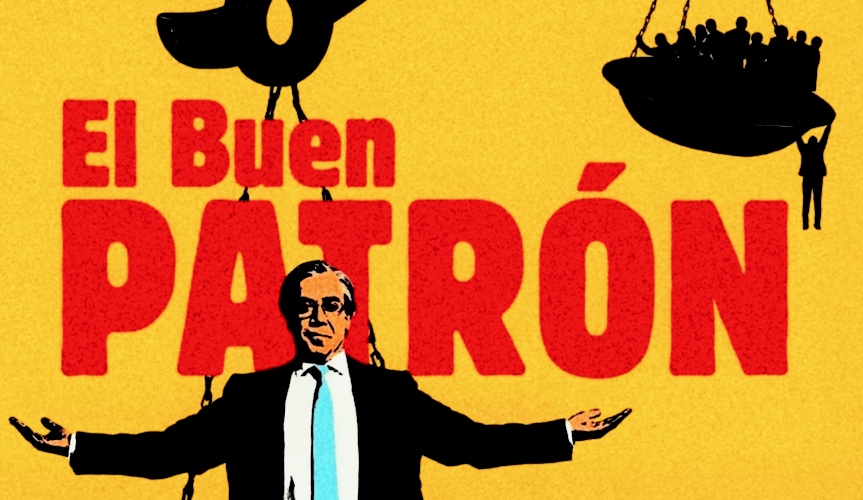
© 2021 Reposado Producciones
Fernando León de Aranoa is one of the biggest names in Spanish cinema. His penchant for stories with a strong social core and human characters, his crossovers into the English language, as well as his collaborations with actor Javier Bardem have won him acclaim. Most recently, the satire El buen patrón (tr. The Good Boss) — his third team-up with Bardem — won six Goya Awards, including Best Picture, and was Spain’s official submission at the 94th Academy Awards in 2022. But that wasn’t always the case for him.
“I always liked movies, but I never thought my future would be so closely tied to cinema”, León de Aranoa tells me. He started out as an artist. He loved drawing and thought he would work as an illustrator. A screenwriting workshop changed everything. “[It was] three weeks with three different tutors who were professional screenwriters in Spain. I always say it was a moment of revelation, of falling in love with cinema.” The world of stories opened before León de Aranoa and he set off to discover its possibilities.
He first started working as a screenwriter in television. But he knew his heart was set on cinema, so he spent his nights writing films until, finally, he sold his first script to a producer. “That was how I realized that this is what I want to do with my life: write movies.” His decision to direct came shortly after. León de Aranoa saw it as a means to become a better writer. He wanted to understand what happens on a set and the dynamics between director and actors, so he directed a short film and enjoyed it so much that he decided to keep doing it.
His next script, he wanted to keep for himself. Telling the story of a lonely middle-aged man who hires a group of actors to act as his real family, the script became Familia (tr. Family), his first feature released in 1996. After Familia, León de Aranoa kept alternating between writing and directing, but he remained a writer at heart. “I’m a writer who directs”, he self-describes. “After eight features and a few documentaries, I think these two facets of my life are more balanced, but writing was very important. The moment of falling in love was very specific and happened in a screenwriting course.”
Love may be a powerful fuel, but León de Aranoa admits that the journey of a filmmaker is far from straightforward. “You can’t make a film in one night. [It] … takes a year, two years, three years. It’s a marathon.” Faith can be hard to come by when one has to prepare themself to run for years, but León de Aranoa offers a piece of advice: “Talk about something that matters to you a lot, that you feel very connected to.” His films have always been made with passion, with the idea that they were important to him personally and that they had something to say. “If I weren’t so invested in the stories I’ve written and made, I think it would be very difficult.” He sees making a movie as a long conversation that goes on for years, with different interlocutors: first, as a writer, with oneself or with a co-writer. Then, with the actors and the crew before it finally reaches critics and audiences. “If you’re going to spend so much time talking about the same topic, it must be something that interests you. Otherwise, you will get bored along the way.”
Making a film is a challenge in itself, but León de Aranoa never shied away from taking on additional challenges in his career. His decision to make his first film in English came as a way to accommodate the story. A Perfect Day follows a group of rescue workers of different nationalities at the end of the Yugoslav Wars. “The way I see it, these teams of workers are always very international. They are formed by a Spaniard, an Italian, a French person, an English person, an American, a Russian. And that makes it more interesting because it’s like a small Tower of Babel.” This can make comprehension difficult and can add to the chaos of a conflict zone which is the focus of A Perfect Day. The English language was thus the natural choice. “English is the language spoken in wars. It’s the international language known by everyone … a broken English, an imperfect English. That’s what I like about the film as well. That’s what it’s like in real life, and that’s what we aim for.”
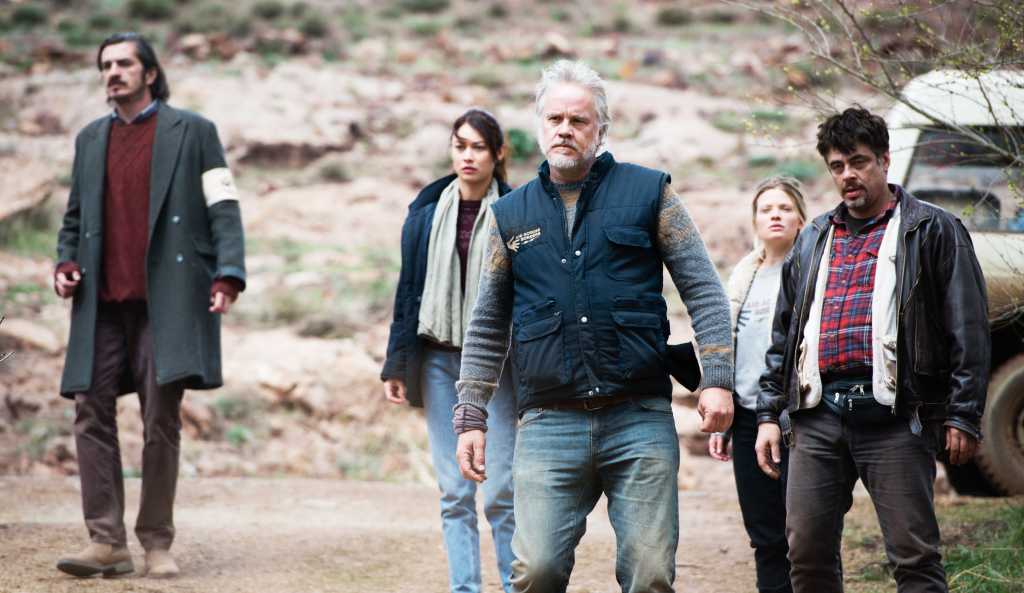
A Perfect Day © 2015 Reposado Producciones
The making of A Perfect Day was a process as challenging as it was enriching for León de Aranoa. Using English to write instead of Spanish was like using “a much clumsier tool” than his usual “scalpel”, but it also allowed him to closely work with a translator. “[Toni] [sic] is a great translator. He … knows my style very well. The dialogue is important, and he helps me convey exactly what I need from each character.” León de Aranoa describes the process: “We communicate a lot. [Toni] does a first translation of the script and dialogue. He gives it back to me, and I work on it. I doubt and I challenge, saying that a particular word may not be the best because it lacks the exact nuances I need, and I show him my version. He gets mad at me and shows me his. Then I get mad at him and show him mine [laughs].” The result? “I remember a review from … The Guardian. … [They said] it seemed unbelievable that the dialogue in English sounded that way coming from a Spanish writer.”
Directing, León de Aranoa felt more comfortable. “It was my knowledge of English that helped me direct the film.” Working with Benicio del Toro, who could understand him in both English and Spanish, and the rest of the cast also helped.
When it comes to his most recent film, El buen patrón, León de Aranoa says that the idea behind it started with its protagonist, Julio Blanco, played by Javier Bardem. Blanco is the owner of a scales factory in a provincial Spanish town. His quest to obtain an award of excellence for his business drives him to meddle in his employees’ lives, exposing a toxic work environment in the process. Even so, Blanco firmly holds onto his ambitions. He paints over the cracks with such conviction that he manages to sell a fabricated image of perfection and to get the validation he so desperately craves… at the low price of a body and his own sanity.
According to León de Aranoa, Blanco’s story followed him for “ten, maybe twelve years”. What interested him in particular was Blanco’s tendency to go way too far. From there, he followed the character, beginning to imagine the ways in which he inserts himself into the lives of his employees. A few defining scenes would appear to him. These scenes, where Blanco’s modus operandi is on full display, León de Aranoa calls “cornerstones” — they are the foundation of the character. The rest of the film is built around them.
In his first films, León de Aranoa concerned himself with plot and structure. He quickly understood, however, that most important to him are the characters. “A film must take you by the hand and lead you to the end. That’s what the characters do … . The story can be very good, but you have to fall in love with the characters. You have to see them as people you’d like to hang out with, as people you know very well.” Audiences need interesting characters because when they care about the characters, they care about what happens to them and they will stay with the film to the very end.
Blanco isn’t anything if not interesting. He constantly shifts between charisma and despicability without ever crossing the line into caricature. It’s a delicate balance perfectly struck by León de Aranoa’s screenplay. But what is truly remarkable about Blanco is the empathy we can’t help but find ourselves feeling for him. This was one of the aspects that terrified León de Aranoa most about making the film. “Blanco is a character that embodies the abuse of power.” At the same time, he was interested in the story because he believes it is something that we can each resonate with: “Any of us can be tempted to use the power we have over others.” Many of Blanco’s employees resort to using the power they have over their colleagues, albeit to a much smaller degree than their boss. Nevertheless, León de Aranoa offers a few potential reasons for why audiences might empathize with Blanco specifically: “It’s in the [film’s] humor, possibly. It’s in something that’s in the film’s DNA because [Blanco] is a character that suffers a lot throughout the film and there’s always empathy for suffering.”
The work with the actors is also very important in bringing out the different nuances in a character. Of Bardem, León de Aranoa has to say: “Javier [sic] is fantastic because he has a sense of humor and understands the character very well. He can get you to feel affection for someone … like Blanco who is a terrible person.”

Javier Bardem as Julio Blanco © 2021 Reposado Producciones
The ending of El buen patrón, perhaps one of the film’s finest moments, offers no resolution for the audience. Things go Blanco’s way and the punishment never comes. León de Aranoa considered different endings before settling on the version we see, but he always knew that he wanted to shoot the scene of the committee’s arrival. Set to Michael Bublé’s “Feeling Good”, the sequence is almost like a commercial, exposing the irony in Blanco’s character. Everything is perfect — the factory, spotless and the employees, one big happy family — as Blanco, dressed in a light gray suit that looks as though it shines, greets the committee with a grin on his face. In reality, we know very well what he is hiding.
By comparison, the film’s closing scene leans towards ambiguity. There is a brief moment where it seems like Blanco might feel some remorse for what he’s done, but he quickly brushes off any trace of feeling so he can once again assert his power over an exploited employee who may or may not get his revenge. This ending, which — according to León de Aranoa — sees the film close earlier than the story, leaves things slightly open. But León de Aranoa believes the audience has enough information to deduce what could happen: “You leave all the narrative mechanisms activated, but you don’t detonate them. … You let the viewer detonate them afterwards. In their mind, at home, talking to a friend. And that’s what I find very interesting because you make the viewer an active participant in the film. … You make them a co-writer of your film.” León de Aranoa leaves us with a moral dilemma to ponder and to decide for ourselves how far we want to see this situation go.
Not all of his films have reached the same level of acclaim as El buen patrón, but León de Aranoa feels at ease when he looks back on his career so far. “Everything you do nourishes you. Everything you write is of use. … All of it made me the director and the screenwriter I am today.” He has had the privilege of always having made the films he wanted to make, and even if some films didn’t turn out the way he wanted, he can’t blame anyone else. “My eight films are my projects that I deeply desired and longed for. … If something went wrong, it’s my own fault. … I can’t even blame the screenwriter, which is something that happens and can be quite ugly [laughs].” León de Aranoa knows that mistakes will inevitably happen, but every experience can be a lesson and he doesn’t regret any of the films he’s made.
When I asked him what he would say to a screenwriter at the beginning of their journey, León de Aranoa was encouraging: “I would tell them that they’ve chosen the best career in the world.” He thinks that someday, he might quit directing to solely focus on writing. “At the screenwriter’s desk, everything is perfect. … When you write, you’re truly free.” When he is in his office, León de Aranoa has the privilege of welcoming his characters into the world and of getting to know them before anyone else. “It’s a beautiful moment that only a screenwriter has access to.” But as beautiful as that moment may be, it doesn’t happen instantly. “You have to write a lot”, he advises. “Even when no one buys your scripts, … write, write, write.” The more one writes, the more one improves, even without realizing it.
“Even when things aren’t going well, keep writing because, … when you write and it’s not turning out as beautifully as you want, that’s normal. It’s rare for every writing day to be a good day.” But every day, every moment one spends writing, counts. “… To have one good hour of writing, you need to have eight bad ones. Eight hours where nothing works, … where the dialogue makes no sense, where you don’t like what you’re doing. But then, you have one or two really good hours. And to have those two good hours, you have to go through the other eight.” As writers, we have to be prepared to keep going because the moment where everything falls into place might be just around the corner.
 MARIA NEAGU